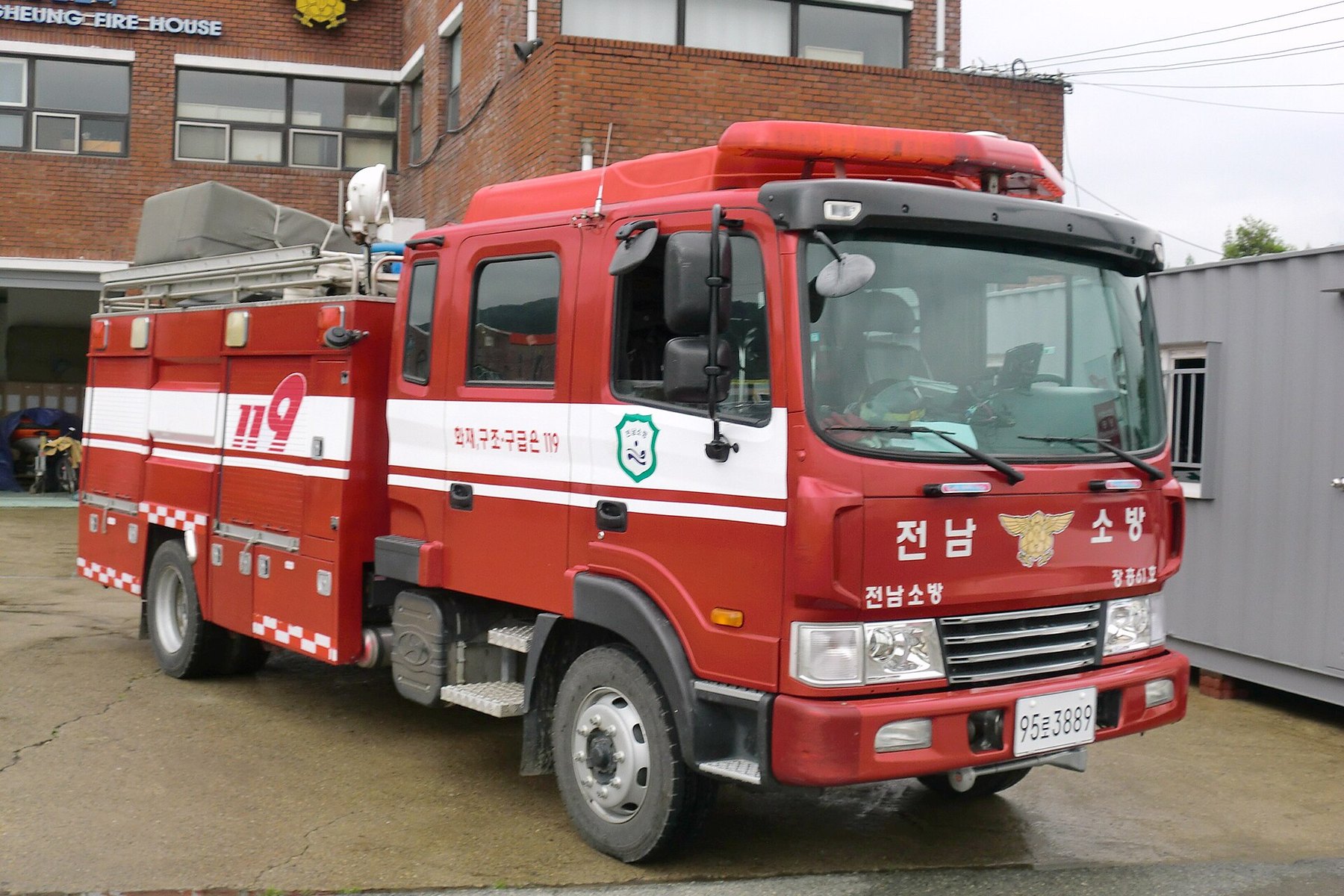
Photo: hyolee2 · Fire engines of Gangjin.JPG · CC BY-SA 3.0
The National Assembly's Public Administration and Security Committee on November 16 added 2.0331 trillion won to next year's budget proposal for the personnel costs of local firefighters. According to Fire Prevention News, the committee explained that this money would raise the state's share of those costs to 30%. This year, cities and provinces pay 91.6% of firefighter personnel costs, and the state pays 8.4%. In city and provincial fire budgets, the share of project spending on equipment, firefighter safety and similar items fell from 30.5% in 2021 to 24.2% this year. So how was this 30% calculated?
Depending on the method, next year's state share can be 29% or 35%. A National Assembly Budget Office (NABO) report estimated next year's firefighter personnel costs at 6.9377 trillion won. The new 2.0331 trillion won is 29.3% of that amount (NEXT calculation). But the government's proposal already includes 422.5 billion won from the fire safety grant for personnel costs. The state takes part of the individual consumption tax on tobacco and sends this grant down to cities and provinces, so NABO also counts it as a state burden. Adding the two brings the state's share to 35.4% (NEXT calculation).
Whether the grant counts toward the 30% changes the new money needed by 422.5 billion won. If the grant is included in the 30%, the new money needed is 1.6588 trillion won. If the state pays 30% apart from the grant, the cost is 2.0813 trillion won (NEXT calculation).
The 2.0331 trillion won the committee added is closer to the figure that excludes the grant. It is 48.2 billion won away from 2.0813 trillion won and 374.3 billion won more than 1.6588 trillion won. Counting only the new money, 30% is roughly accurate. In that case, the state's total share next year is in the 35% range. The reported committee explanation and the NABO report do not state the basis for calculating the 30% or whether the grant is included.
A different personnel cost estimate would also change the 29.3%. For 2.0331 trillion won to be exactly 30%, next year's personnel costs would have to be 6.7770 trillion won (NEXT calculation). That is 160.7 billion won less than the NABO estimate.
If the state keeps paying 2.0331 trillion won, its share falls below 30% in 2031. NABO projected that personnel costs will rise to 8.7824 trillion won in 2031 and that the grant's portion will stay in the 500 billion won range. Assuming the same amount is paid through 2031, the share including the grant is 34.4% in 2028 and 28.9% in 2031 (NEXT calculation). Keeping the new money alone at 30% would cost 2.6347 trillion won in 2031. That is 601.6 billion won more than now (NEXT calculation).
If the money is paid as a subsidy, the amount for 2028 will be set again in the 2028 budget. The Local Finance Act allows the state to give subsidies to local governments within the budget. The Subsidy Management Act requires subsidy amounts to be set in each year's budget. There is a general basis for paying the money next year, but these provisions do not set an amount for 2028.
Current law does not list state subsidies as revenue for the personnel account of the special fire accounts. The Special Fire Accounts Act names three sources of revenue for this account. They are part of the grant, transfers from city and provincial general accounts, and part of the regional resource and facility tax, a local tax. State subsidies are revenue for the project account, which pays for equipment, facilities and similar items. The route for the new 2.0331 trillion won has not yet been decided.
The figure of 30% does not appear in any of the four bills to amend the Special Fire Accounts Act either. The bills by Reps. Kim Jae-sub and Jung Chung-rae would have the state cover any shortfall in personnel costs. The bills by Reps. Lee Un-ju and Cho Ji-yeon would have the state pay at least 80% of personnel costs. All four have been referred to the Public Administration and Security Committee, the standing committee in charge.
The government also says it has not yet decided how to provide the support. According to Fire Prevention News, Minister of the Interior and Safety Yun Ho-jung answered on November 16, "This time, we did not decide even the method of state support." He said the funding would be discussed and decided by the fiscal decentralization task force at the Office of the Prime Minister. The methods he gave as examples were converting national taxes into local taxes or raising the local allocation tax rate. Money from national taxes converted into local taxes becomes local tax revenue. The minister's answer does not say whether this would count toward the 30% state share.
Does the 30% include the grant or exclude it? In 2028, will the state keep the ratio or only the amount? The Special Committee on Budget and Accounts subcommittee that could answer these two questions is scheduled to review the budget through November 27, and the deadline for passing the budget is December 2. The 30% state share cited by the committee is a number that describes next year's budget. It is not a ratio the state has written into law to keep every year.
Sources
- National Assembly Budget Office, NABO Focus No. 180, "Current State of Fire Service Finances and Future Tasks", November 19, 2026. Page 2, Table 1 (project spending share) and Figure 2 (2026 burden shares); page 3, Table 3 (2027 to 2031 personnel costs and grant portion).
- NEXT calculation method: We divided 2.0331 trillion won, and 2.0331 trillion won plus the grant portion, by each year's personnel costs in Table 3. We also calculated 30% of personnel costs and that amount minus the grant portion. We divided 2.0331 trillion won by 0.3 to find the personnel costs at which it equals 30%. Figures for 2028 and later assume the same amount is maintained.
- Fire Prevention News, the committee's new 2.0331 trillion won and Minister Yun Ho-jung's answer, November 17, 2026. The minister's answer follows this report.
- National Law Information Center, Act on Fire Service Finance Support and City and Provincial Special Fire Accounts, Articles 5 to 7, checked November 24, 2026.
- National Law Information Center, Local Finance Act, Article 23, checked November 24, 2026.
- National Law Information Center, Subsidy Management Act, Article 9, checked November 24, 2026.
- National Participation Legislation Center, bill by Rep. Kim Jae-sub (No. 2221954), October 19, 2026.
- National Participation Legislation Center, bill by Rep. Jung Chung-rae (No. 2222001), October 21, 2026.
- National Participation Legislation Center, bill by Rep. Lee Un-ju (No. 2222017), October 22, 2026.
- National Participation Legislation Center, bill by Rep. Cho Ji-yeon (No. 2222550), November 6, 2026.
- Edaily, weekly schedule (Budget Committee subcommittee review, November 23 to 27), November 22, 2026.
- Yonhap News (carried by Supple), Budget Committee subcommittee review begins and December 2 plenary deadline, November 16, 2026.
Translated from the Korean original published on November 24, 2026.
Korean original: 소방 인건비 국비 30%라더니…계산법 따라 29%도 35%도